

The Power of Compounding
When I was 19 years old, in the summer of 2001, I was between my freshman and sophomore years of college.
My financial situation: I had free room, board, and tuition at college. I had a full ride.
I had a full ride because when I was 14 years old, I decided I didn’t want any college debt, so I set out in high school to obtain great grades and a high SAT score for the purpose of earning an academic scholarship.
(There was also an adult who told me it wouldn’t be possible to graduate without debt and I mentally said “fuck you” to them. This motivated me to prove them wrong.)
I wasn’t smart enough for the Ivy League, but I put together a good enough academic record in high school to get a free ride to a state school through raw effort.
I maintained a schedule of 8 AP classes. I’d often come home from high school at 3:30-4 and it would not be unusual for me to study & do homework until 11 PM, only breaking for dinner.
I used to pretend that every assignment I received an “A” on was worth $1,000 in future tuition reduction, which kept me motivated.
Despite my scholarship, I was fairly cash poor.
I spent most of my freshman year not spending any money whatsoever. I went to class. I ate at the cafeteria on my meal plan. I spent a lot of free time in the library reading books, newspapers, and magazines. I didn’t work because college was great and I didn’t need to.
On the weekends, I went to parties, but it was only about $3 to get in the door. I’d go to the movies, but that was less than $10.
I sought to rectify this situation between my freshman and sophomore years. I wanted to have some more ample spending money during the school year.
I applied to a bunch of office temp agencies before the summer began. One particular temp agency offered me a decent job at a title insurance company for $9 an hour.
In 2001, $9/hour was pretty good money for a 19 year old. Minimum wage was $5.15 back then and minimum wage jobs sucked back then as much as they do now. $9 to work in an air-conditioned office was pretty sweet.
I moved back in with my parents for the summer, which eliminated the need to spend money on rent and food. The office was close enough that I could ride my bike to it.
I resolved to live like a monk and do absolutely nothing that was fun or required me to spend money. I didn’t go out at all. Friends would call and I’d just say I was busy.
I simply banked every paycheck.
It was a very productive summer.
I saved nearly 100% of every paycheck. I actually remember the amount of each check after taxes: $286.
I didn’t have a car, so after work I’d literally run to the bank before it closed and deposit the check.
The benefits were not only financial.
Because I made a decision to spend $0 that summer, I filled up my free time by exercising. I did cardio—running around my neighborhood, biking to work, and running in place in my parents’ basement—along with push-ups and sit-ups, and I got into great shape. The best shape of my life, actually. I lost about 30 pounds. This was the only time in my adult life that I had a flat stomach.
By the end of the summer, I had about $3,400 in my account.
This was enough money to ensure that my mini-fridge was filled with booze throughout the school year. It was enough money to frequently order pizza on a whim. I’d even have enough money to take a girl out for an off-campus date on occasion (I had no girlfriend that summer, but I was aspirational).
Saving $3,400 was hard.
I worked for a title insurance firm. My job was ordering title reports from various title abstractors throughout the country.
We were still using fax machines. I’d call abstractors all day and ask them to fax me their reports. I’d find the faxed reports in a stack of other docs in the fax machine and then I’d assemble formal reports for the underwriters. I also spent a lot of time chasing delinquent abstractors.
I kept it all organized and I put enough pressure on the abstractors to do well at the job. (I was able to put on a very serious adult-voice and get people’s attention.) There was no downtime at the job and I was running around the office, updating their system on the computer, and on the phone all day.
I also made the sacrifice of having zero fun that summer, for the express purpose of banking nearly 100% of every paycheck.
Anyway, $3,400 remained a lot of money to me for many years.
(Years later, when I was in $40k of debt in my late 20’s, I often found myself wishing I was 19 years old again with $3,400 in the bank. The contrast helped me understand the visceral nature of the carefree bliss of not owing anyone anything vs. the crushing emotional weight of debt.)
Fast forward to 2026. On a random uneventful day last week, my portfolio went up by $6,448.
That kind of volatility is an extremely normal occurrence. This sort of thing happens daily. It happens on very boring days in the markets.
On a really eventful day, my portfolio can jump up or down by $15,000 or more. That’s almost 40% of the money that I spend in an entire year. That’s almost what my current car is worth.
These kinds of gyrations happen all the time even though I have a fairly conservative asset allocation.
Despite my intellectual understanding of market volatility, this is still insane to me on an emotional level when I think back to a time when $3,400 represented an entire summer of working and saving.
These days, $3,400 is what I consider a “flat” day for my portfolio.
Fourteen years of saving 60%+ of my income—even more than that in the 2020s, after my income passed the $100k mark in 2019—has created this situation where relatively small daily movements in my portfolio can add up to more money than I used to make in an entire year as a college student.
In fact, last year my portfolio increased by an amount that was almost equal to my current pre-tax salary. It was a very good and unusual year. But, still. Holy shit.
This is all because of compounding.
I visualized all of this on a spreadsheet when I first started saving and investing large chunks of every paycheck around 2012ish.
I fantasized about the day when my portfolio could move like this. I knew, mathematically, that it would happen eventually as long as I maintained the discipline of a high savings rate combined with consistent investing.
It’s one thing to see this on a spreadsheet as a far-off fantasy. It’s completely another to see it happen in real life.
Now that it has arrived, it’s still completely insane to me on an emotional level.
It barely feels real.
My point here is that when you have a high savings rate and invest for a long period of time (which is happening for anyone seriously pursuing financial independence), eventually your portfolio will begin jumping around by amounts that seem absolutely insane to you.
I think that level is when you should change the way you ought to scale back risk vs. a years-until-retirement conventional framework.
Years to Retirement vs. Dollar Level Framework
Among financial advisers, there is often a lot of talk about the “accumulation” phase of a portfolio and the “decumulation” phase.
“Accumulation” is when you have a long savings runway. In that phase (usually your 20s and 30s), you can get really aggressive with a JL-Collins-style 100% stocks portfolio.
Then, when you get closer to retirement, you enter the “decumulation” phase. That’s when you should own more diversifiers that result in less volatility and shallower drawdowns so your safe withdrawal rate can be more reliable.
The conventional explanation is that as you get closer to retirement, you should start getting more conservative and move into a less volatile portfolio.
I don’t think that this framework is quite right. At least, it’s not quite right for people aggressively pursuing financial independence at an early age.
My unconventional view is that this should happen even earlier than that, at least for folks pursuing financial independence. It should happen when the volatility in your portfolio results in impressive dollar figures for you.
For me, I started to become really impressed with the moves in my portfolio when I hit around $100,000. My portfolio would move by $1,000 on a big 1% market day, and this seemed insane to me at the time on an emotional level.
I also realized that if the 2008–09 GFC drawdown happened again, I’d lose about $50,000.
This seemed unacceptable to me.
That’s when I started becoming more interested in asset allocation and strategies that reduced volatility and drawdowns.
Risk vs. Return
Portfolio Charts was actually one of my first wake-up calls that simply gritting my teeth through drawdowns wasn’t the only strategy available.
The kinds of portfolios featured on Portfolio Charts—which usually involve some combination of stocks, Treasuries, and gold—usually have returns that aren’t significantly worse than what you’d experience with 100% U.S. stocks.
For instance, my own creation, the Weird Portfolio, has an average long-term real return of 7.6%, while the total stock market has returned 8.2%.
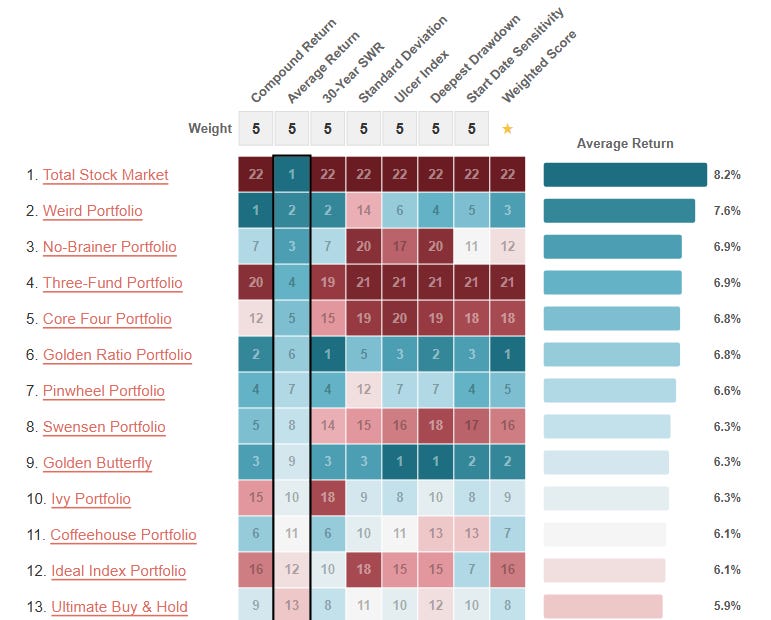
Yes, that .6% difference adds up to a lot when compounded over 50 years.
However, I still think it’s a decent trade-off when the portfolio cut the Global-Financial-Crisis drawdown in half.
Simply take a look at the drawdowns below.
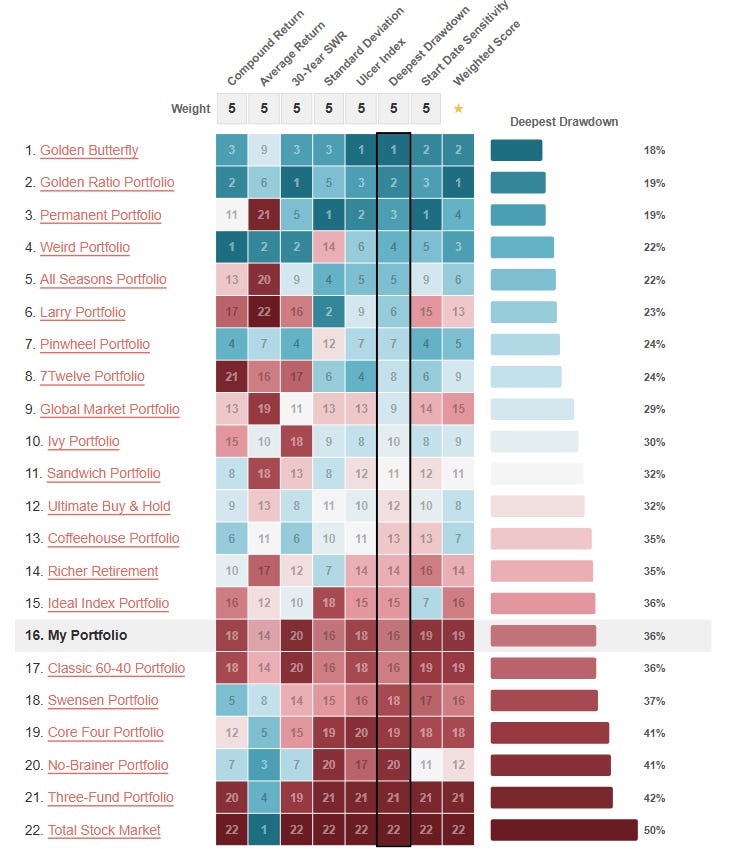
I think that the .6% lower average returns of the weird portfolio (compared to 100% US stocks) is worth it.
That’s why I think the better way to think about this issue—when to adopt a diversified portfolio versus a more aggressive one—has more to do with the amount of money you have and less to do with the number of years until retirement.
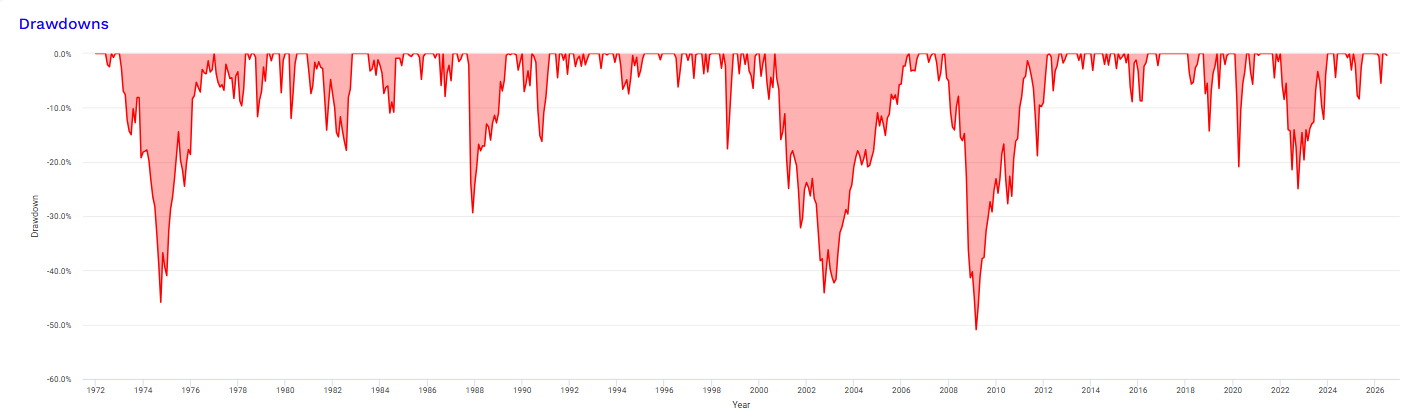
After all, there have been about three 50% drawdowns over the last 50 years.
I have zero doubt that this will happen again, at some point. Predicting this kind of thing is impossible (a topic for a future blog post), but it’s reasonable to expect that it’s going to happen eventually.
It’s reasonable to assume that we’ll probably experience at least three more over the next 50 years. Based on the data, it’s also reasonable to expect a 20-30% drawdown at least once every five years.
If your portfolio is large enough that losing half your money makes you think, “Holy shit,” it’s probably a good idea to embrace some other assets, like Treasuries, to blunt the impact of the next major drawdown.
The “Holy Shit” Level
There are probably specific dollar amounts that will make you say “holy shit.”
You know your dollar figure better than I do.
If you’re a 25-year-old with $10,000 in your 401(k), then losing $5,000 shouldn’t be seen as a big deal. You have decades of saving & investing ahead of you. You weren’t going to spend the $5,000 locked up in the 401(k), anyway. In the grand scheme of things, it’s not a lot of money.
But as your portfolio grows, you’re eventually going to hit a “holy shit” level where losing 50% of it becomes a very big deal to you in raw dollar terms. It’s important to identify what the “holy shit” level is for you.
For me, I hit that “holy shit” level pretty early at only $100,000 invested.
Losing $50,000—which was roughly 60% of my annual income at the time—would have completely freaked me out.
Needless to say, I have a fairly low risk tolerance compared with a lot of more aggressive, gun-slinging investors.
Despite varying degrees of risk tolerance, I think everyone has a “holy shit” number. For Warren Buffett, this is probably something like $80 billion. To others, it’s probably even lower than mine.
Most people pursuing FI (financial independence) will hit that “holy shit” zone long before most financial advisors recommend embracing more diversification.
If you’re pursuing FI and you’re saving and investing a big chunk of your income, you will probably hit that number well before you enter your 50s.
That’s why I think it’s okay for FI-pursuing investors to shift to a decumulation portfolio earlier, even long before they actually start decumulating.
So rather than using something like your age or your number of years until retirement, I’d try to gauge your personal “holy shit” 50%-drawdown level.
That’s probably the point at which you should embrace more diversification.
Personal Risk Tolerance
What’s your risk tolerance?
On the surface, this is only about dollars.
As discussed above, the first level of this is looking at the value of your portfolio and thinking about whether the next 50% bear market will make you say, “Holy shit.”
The next level is simply looking at your risk tolerance in other areas of your personal life.
For me, it should be no surprise that my risk aversion in my portfolio correlates very strongly with my risk aversion in real life.
For instance, I have never been on a motorcycle, and I have no plans to ever get on a motorcycle because I see them as tools that put people in handicap parking spaces and/or splatter skulls on the road like a broken watermelon.
Despite my love of the movie Point Break, I will never go skydiving.
I fill up my gas tank when I’m at half a tank.
In my 20’s, I used a “club” theft deterrent device regularly on a $3,000 car in suburban low-crime neighborhoods.
I have a low risk tolerance.
If you find skydiving exhilarating, let your gas tank drop to E and wait for the light to come on, then you probably don’t need to be as conservative an investor as I am.
You have to objectively know yourself.
The Good News
If you are risk averse like me, the good news is that I don’t really think you need to sacrifice much in returns to get significantly more safety.
Here is a portfolio I designed recently that demonstrates this.
It’s 20% VT (total world market), 20% VIOV/AVUV (USA Small Cap Value), 10% AVDV (international small cap value), 20% VGLT (long-term treasuries), 20% GLDM (gold), and 10% VGSH (short term treasuries). It delivers nearly the same return as 100% VT (approximated as 1/2 US, 1/2 international). Rebalanced annually.
(Yes, I know this isn’t an apples-to-apples comparison of the funds. You should settle down.)
Here it is below. Here is a link.
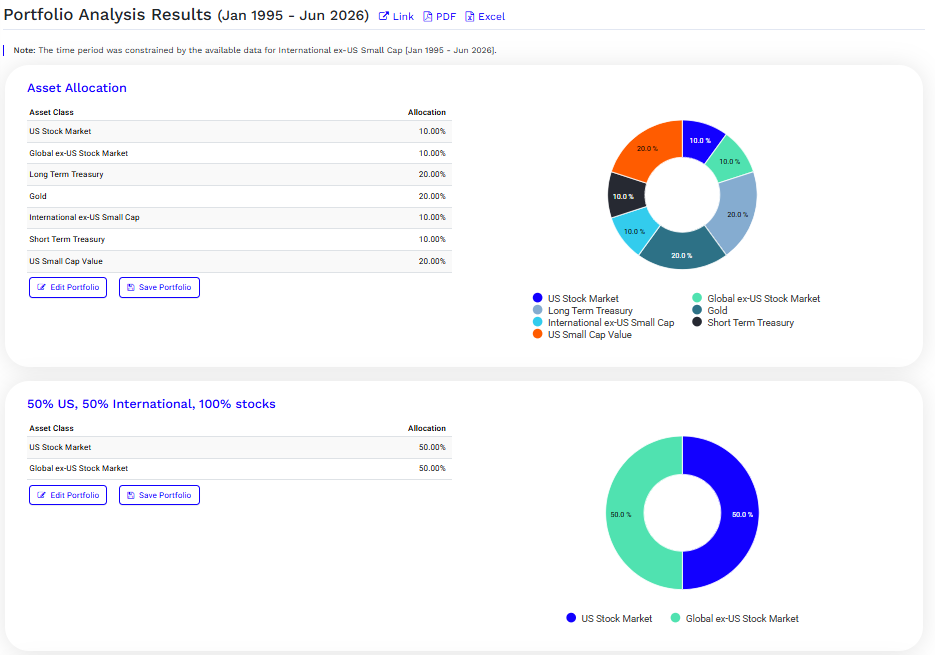
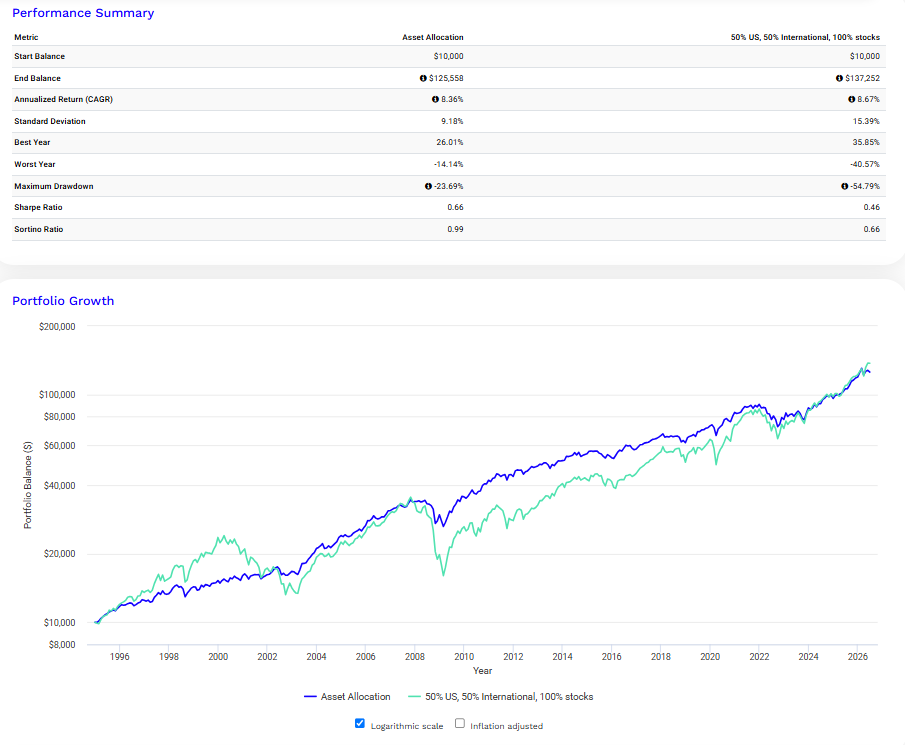
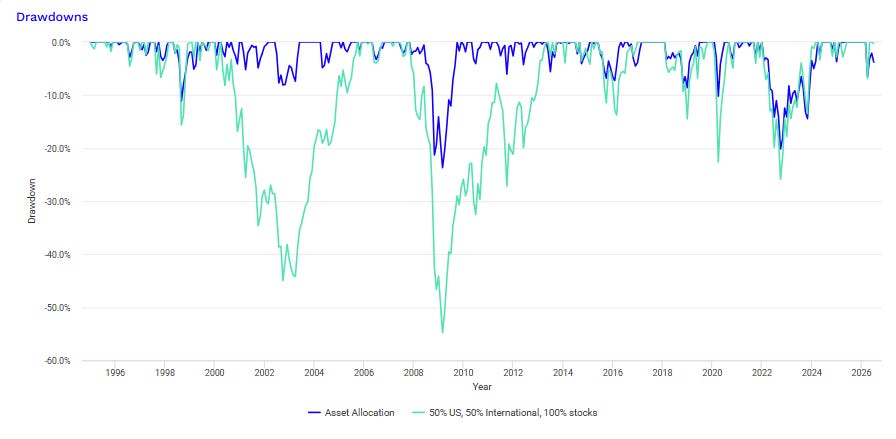
The portfolio achieves a return that’s pretty damned close to the total world market with a fraction of the risk.
This very basic portfolio that anyone could implement with a laptop and a brokerage account. You could implement this in your underwear.
You do not need to be the second-coming of David Swensen to do this. In fact, you’d likely outperform most institutions paying absurd sums in staffing & fees who are trying to be the second-coming of David Swensen.
Anyway, there are lots of portfolios like this.
Comb through the portfolio data on something like Portfolio Charts and decide on an asset allocation that works for you, with a trade-off between returns and risk that you can actually live with.
There are also other tools like Simba’s backtesting spreadsheet, testfolio, and portfolio visualizer. It’s worth thinking through all of them.
Conclusion
I don’t think your age is what tells you when to diversify.
Dollar levels and risk tolerance tell you when to diversify beyond 100% stocks.
If you have a low risk tolerance, then you should probably embrace more diversification when 50% of your portfolio is an amount that will make you say “Holy shit” if you lose it.
There are many asset allocations that can achieve this.
This is worth thinking about when markets are tranquil, as they pretty much have been since 2009. You don’t want to have to think about it during the chaos of a 2008 scenario.
This is particularly worth thinking about if you are aggressively pursuing FI. You’ll be at the “Holy shit” level long before your 50th birthday.
this is very cool. I really do like your story.
I find treasuries more palatable to hold when they are matched to liabilities. I’ve defeased my mortgage this way with nominal bonds and am working on TIPS rungs for property tax. This way I feel like no matter how bad it gets in the equities market, I’ll never lose my home. Consequently, I’ll be less likely to panic.