People Really Hate Inflation

No Shit, VSG
You may have read the title of this post and said, “No shit.”
For me, I’ve never really perceived inflation as a major problem. I’ve always looked more to the unemployment rate as a source of anger and economic misery.
I’m often taken aback by the anger and outrage people have about inflation on social media.
You see, I have blinders to inflation for reasons I’ll explain in this post, while I have a visceral understanding of unemployment.
For instance, there was a lot of talk around 2021–22 about a “vibecession.”
At the time, I thought this was stupid.
From my POV, the economy was roaring by all metrics at the time. However, everyone was miserable. This was perplexing to me because my main memory of economic misery was the high unemployment during the financial crisis and the years that followed. I thought this was simply people spending too much time on social media.
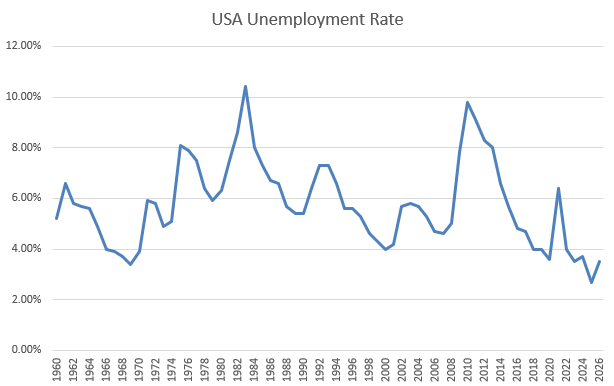
My attitude was that unemployment was below 1999 levels, so things were largely fine. Unemployment was 4% in 2022, compared to 4.3% in 1999, my previous memory of widespread prosperity. So, my attitude was: What are y’all bitching about?
For me, the unemployment rate was the definition of economic misery, for reasons I’ll also explain later in the post.
Unemployment As Economic Misery
For me, 2008–12 was the definition of a “bad economy.”
For context: I was paying down about $40,000 in debt. In 2007, I spent some time living out of my car and couch surfing after losing my job. Once 2008 hit, I was terrified of losing my new job and slipping back into homelessness. I also routinely saw people packing up boxes at work, so I was stressed out about losing my job all the time.
It’s also worth noting that during the 2007–12 period, I was doing okay, but I wasn’t exactly making big money. I had very little margin while paying down the debt I had at the time.
For those curious, here are my actual Medicare earnings during this period:
2007: $36,567
2008: $47,352 (Includes a $1,000 bonus)
2009: $46,961 (No increase in 2009, and they cut the bonus to $0.)
2010: $49,690
2011: $61,463 (My employer started paying overtime this year. Before that, most of my coworkers and I would work 12+ hour days and feel grateful to simply have jobs. Someone sued them, and they started actually paying us for the extra time in 2011.)
2012: $59,551 (They started putting limits on my overtime.)
Fortunately, I spent those years fully employed, but I was stressed the entire time about losing my job.
I knew that a job loss would kill my momentum in paying down debt. I also had a visceral memory of the last time I lost my job in 2007: I spent my time couch surfing, some nights sleeping in my car, with most of my possessions in the trunk.
I was doing alright 2008-12, but I wasn’t exactly killing it. And, of course, the job market was horrendous.
I applied for other jobs all the time, and it reinforced my point of view that I was lucky to have the job I had.
My employer—and most corporations—had workers by the balls at that point.
The unstated reality of 2009–12 was: “Oh, you think this is bad? Unemployment is 10%. You’re lucky to have a job. Good luck finding another one. Now stop whining and get to work, bitch.”
During this time, I was paying down approximately $40,000 worth of debt—credit cards, my car, etc.
I was also quitting drinking (I haven’t drank alcohol since summer 2008), and most of my debt was credit-card related from all the times I put bar tabs on credit cards, along with debt I racked up while I was unemployed.
In the fall of 2008, I decided to get my life together. I sobered up and focused like a laser on getting out of debt. I rented a cheap unfinished basement. I spent not-insignificant amounts of time surviving on bread and peanut butter. I sold most of my possessions on eBay. I developed a little side hustle selling all sorts of things on eBay.
Anyway, as you can see from my debt and income history, I knew that losing my job would probably drive me back to living out of my car and couch surfing, and completely disrupt all the momentum I had built while paying down my debt.
I worried all the damn time about losing my job. When I closed my eyes when I went to bed at night, I thought about it.
I was recently talking to an old coworker of mine from those days who remarked something like, “We worked so hard because we were trying to be successful!”
Not me. I was not trying to be successful. I was trying to get out of a hole.
At that point in my life, “success” meant not being homeless again. I worked really hard, but it was all driven by a palpable fear that I’d end up living out of my car, again. I was working hard simply to keep the decent job I had. I performed at a high level so no one would even consider laying me off.
All of this is to say that my life experience was primarily rooted in the unemployment rate as a source of economic misery.
Once unemployment eased in the late 2010s, my outlook eased too, and my life improved considerably.
I completely understood the economic frustration of the American people from 2008–12 because I was living it.
Not only was I living it, but the data backed it up. The unemployment rate surged to levels that hadn’t been seen in 30 years. It was pretty easy for me to look at public opinion polls, then look at the unemployment rate, and completely understand what was going on.
Inflation As Economic Misery
What I haven’t been able to connect with is inflation as a source of economic misery.
Following my debt paydown, I’ve continued to live extremely frugally. Much of this is a remnant of being homeless and spending four years paying down $40,000 worth of debt while living in a basement.
For context: I gross close to $200,000 a year now. Meanwhile, I live on about $40,000 a year. I paid off my home and don’t have a mortgage. If I really stripped things down to the bare bones, I could probably live on about $25,000 a year after-tax. In my eyes, the $40,000 is full of extravagance like going to restaurants and improving my modest home.
Much of this attitude is a remnant of my debt-paydown days. Even after I got out of debt, I kept spending at absurdly low levels for years. I kicked it up a little when I bought a house in 2015, but even then, I kept a massive gap between what I made and what I spent.
You might say this was crazy. Then again, living out of your car and spending four years worried about unemployment 24/7 will do a lot to change your perspective on what’s “extravagance” and what’s not.
Back to inflation. Because of my frugality and low expenses, inflation doesn’t register for me.
Gas prices don’t register for me. I’ve always driven fuel-efficient vehicles, and I don’t drive a lot. I go through about five gallons of gas a week. So, a $1 increase in gas prices means I spend about an extra $5 a week.
Grocery prices don’t register much for me. In fact, this morning I went to the grocery store and spent $74. About 1/3 of that was the steaks that I bought for Sunday night, when I’ll grill them up for my wife and I. I still brown-bag my lunch. I bought ham, cheese, and bread for my lunches throughout the week. That was about $24. Some Rice-A-Roni. Some bananas. I got some Hatfield ham steaks and frozen vegetables for dinner throughout the week. Some bottled water. Some snacks.
On average, I typically spend $70-$100 a week at the grocery store.
Travel prices don’t register for me because I don’t travel. The last time I was on a plane was in 2018. I have been on five round trip flights in the last 25 years. This is only partially due to frugality. I find vacations kind of annoying. My favorite part of a vacation is when I get home to my recliner, my books, and my computer.
Housing costs don’t register for me. My house was $180,000 when I bought it in 2015. I had a 3% mortgage. I then paid it off completely by 2024. So, mortgage rates and house prices don’t impact me.
Fast food prices impact me, but not by much. I occasionally go to Chipotle, which I view as an extravagance, and I’ll spend about $10.50 on my go-to burrito. Chick-Fil-A is my other extravagance, and my go-to meal there is about $9.
Inflation in booze prices doesn’t affect me. I don’t drink, so I don’t buy booze and I don’t go to bars.
I take my wife to a restaurant once a week. Special occasions usually call for a very nice restaurant. But, most of the time, it’s something like Texas Roadhouse and the bill is $60-$90.
Additionally, inflation doesn’t register for me because the main times I was really tight for cash—i.e., the 2007–12 period—saw pretty low inflation.
Anyway, as you can tell from all this, inflation barely affects me. I make plenty of money, and there is such a massive gap between what I make and what I spend. This is why I’m completely out of touch with this issue.
That is also why the 2022 “vibecession” took me by surprise. I didn’t really conceptualize how much inflation matters to people.
Similarly, I also had trouble understanding the 1970s. For starters, I was born in the early 1980s, and I didn’t live through the 1970s.
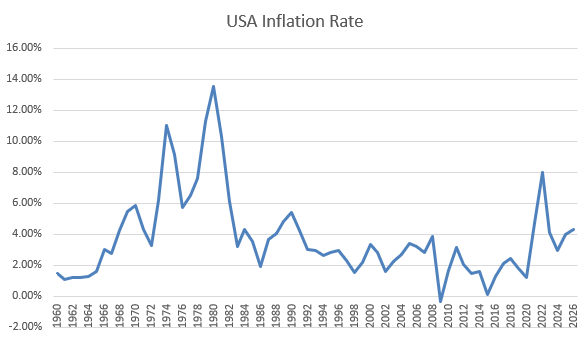
But unemployment averaged only 6.15% during the 1970s. Despite this, by all accounts, everyone was absolutely miserable. During the 1974 recession, unemployment peaked at 8.1%. Bad, but the average for the decade was still only 6.15% which isn’t too bad. Basically, 2015 levels.
Meanwhile, in the 1980s, the country’s mood was very upbeat. That’s why Ronald Reagan won a 49-state landslide in 1984 and George HW Bush won 40 states in 1988.
Oddly enough, unemployment averaged 7.36% over the entire decade of the 1980s. Unemployment was, on average, higher in the 1980s than the 1970s.
The contrast between the euphoric 1980s and the miserable 1970s—wholly dependent on the change in inflation rates—is as good a representation the extent to which people hate inflation.
The Misery Index
There is a great way to measure the twin misery of unemployment and inflation.
The economist Arthur Okun actually put a metric around this: the misery index. It was pretty simple—the annual inflation rate plus the unemployment rate.
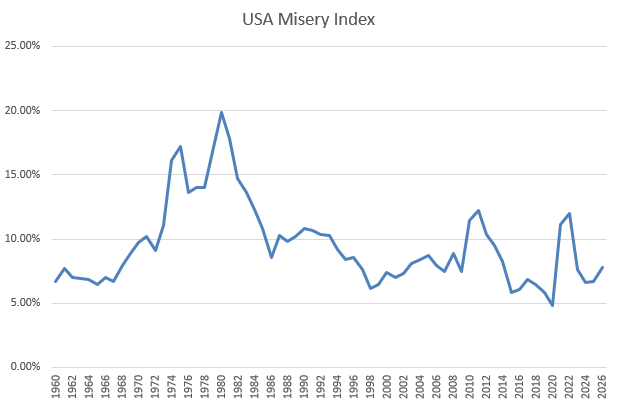
As you can see, the misery index soared in the 1970s and then collapsed in the 1980s. It also conceptualizes how unemployment can be low, and people can still be miserable if inflation is high.
In other words, an 8% inflation rate can be just as miserable to Americans as an 8% unemployment rate.
You can also see from the chart exactly why the vibecession was a thing. We went from all-time lows in the misery index in 2019 to financial-crisis-level highs in 2022. It was a jarring change.
You can also see why people were so euphoric in the late ’90s.
In the 1970s and 1980s, the misery index averaged 13.2%. By 1999, we were down to 6.49%. The last time it was that low was in 1965, when most circa-1999 working adults were either children or hadn’t been born yet. It was literally the best economy they had ever seen in their working lives.
Fucking Bullshit
It’s also worth noting: people hate inflation even when their incomes are keeping up.
There are plenty of people whose incomes do not increase with inflation. Retirees on pensions, mostly. People living off of fixed income portfolios (inflation is a good reason you shouldn’t try to live off of a fixed income portfolio). This crowd was destroyed by the 1970s.
But, for most workers, their incomes respond to inflation and they hate inflation anyway. The response of incomes to inflation is what actually causes any spike in inflation rates to stay embedded in the economy. No employer is going to get away with cutting pay for all of their workers.
However, most people look at increases in their income as the result of their hard work and effort, not inflation. Meanwhile, they look at inflation as just some fucking bullshit.
I experienced this psychological phenomenon when I was more of a stock picker. If I picked a stock and it went up, that was because I was a genius who did great work on the company. If the stock went down, well, that was because it was fucking bullshit. The Fed, oil prices, bad management, etc.
There are fund managers who play this game professionally and do the same thing. The common bogeyman for most of the 2010s was the Fed. These guys have since moved on to passive flows as the excuse of choice. In other words: they pick great stocks but there is just so much money going into indexes that no one cares about the great stocks they’ve picked. Ok, buddy.
All of this is extremely human.
I also witnessed this often as a young man when I went to the horse racing track.
I had weird hobbies when I was 18, including hanging out at a smoke-filled simulcast horse track with 65- to 85-year-old men.
I enjoyed gambling, but what I enjoyed even more was that these degenerates were virtuosos with profanity. I never knew you could be a “double-cunt worthless mother fucker,” for instance. I thought it was bad enough to call someone a cunt, but what exactly was a double cunt? I didn’t have the courage to ask.
Anyway, any time these guys won, they were geniuses. Whenever they lost, it was fucking bullshit.
All of those guys I met at the track celebrated after they won money on a race. They’d explain how they looked at the Daily Racing Form and figured everything out.
In contrast, whenever they lost, it was a tirade of vulgarity about jockeys, mud, wind, and the horse itself.
Sometimes, they’d blame the track itself. I remember one guy losing a bunch of money and saying something along the lines of, “They should burn this shithole down!” as he ripped up his tickets and threw them on the ground.
The interesting thing was that they never blamed their own degenerate gambling in the first place.
The reality was that they were losing money because they had picked up a dumb gambling hobby where it’s almost impossible to make money. The house takes 20% right off the top. That is difficult math to overcome. It’s fun, though.
Failure to Understand Inflation
While I sympathize with the way people hate inflation, I do think most people don’t even understand where it comes from.
During the 2024 campaign, Kamala Harris said she’d contain grocery prices with what were effectively price controls on groceries.
(Well, she didn’t call them “price controls.” She called it “a federal ban on price gouging.” Same thing in my book. Also, your grocery store is not necessarily price gouging you. Kroger had a 0.69% net profit margin last year. Not much room for gouging.)
Price controls have never worked particularly well. She’d probably hate that I’m comparing her to him, but Richard Nixon thought the same thing. He implemented price controls in the 1970s.
To paraphrase Ben Stein in Ferris Bueller’s Day Off: Did it work? It did not work, and the nation sank deeper into the inflationary malaise of the 1970s.
Most of the time, price controls have a very predictable effect: they create shortages. You aren’t letting the market work. You are keeping prices below the levels dictated by supply and demand. Demand for the artificially cheap good overwhelms supply. Suppliers don’t create enough of it. You then have shortages.
This is true of rent controls. This is true of grocery prices.
In the Soviet Union, this was true of everything. This is the main reason that the Soviet Union was an impoverished shithole with empty grocery shelves and shortages of everything. In a communist economy, effectively everything is subject to price controls. As a result, effectively everything is in a perpetual state of shortages.
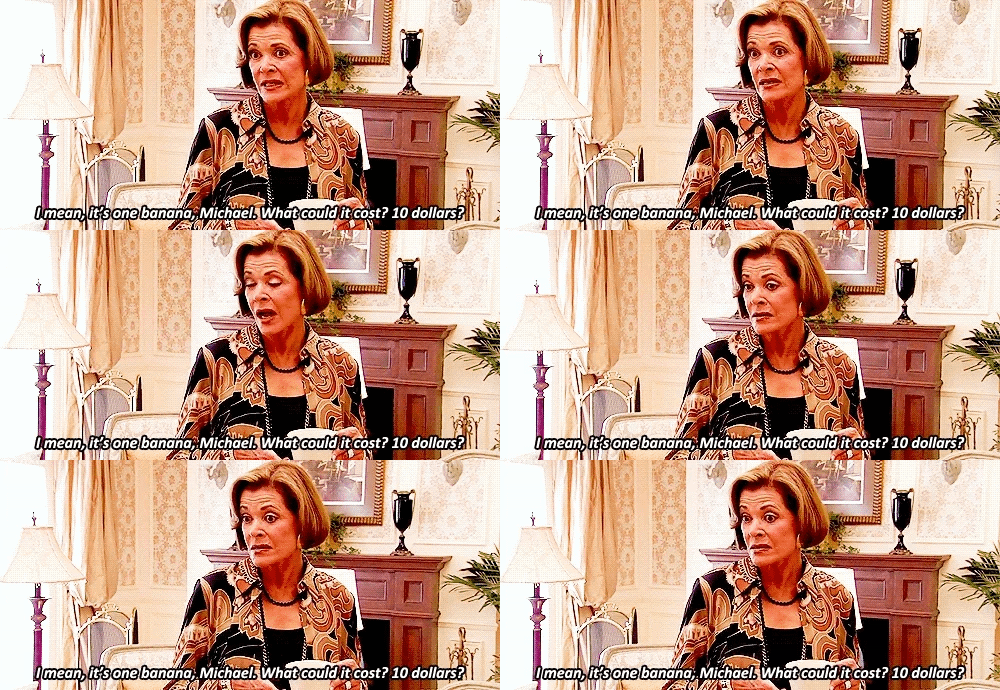
Prices aren’t something made up by greedy capitalists. Prices aren’t something people pull out of their ass. A grocery store can’t sell a $10 banana because people will just go to another grocery store. Or, they’ll just skip bananas that week.
Prices are a result of supply and demand. They’re information. It may not be information that you like, but there isn’t any way you can pass a law and change the fundamental reality of supply and demand.
I think P.J. O’Rourke put this best:
“The free market tells us what people are willing to pay for a given thing at a given moment. That’s all the free market does. The free market is a bathroom scale. We may not like what we see when we step on the bathroom scale, but we can’t pass a law making ourselves weigh 165.”
Failure to Understand Inflation
If everyone is upset about inflation and hates it so much, then I think it’s helpful to clarify what policies actually cause inflation. Here they are, as I define them.
Monetary expansion. This is the most common reason. The Fed prints too much money.
This is the classic definition of inflation: too much money chasing too few goods.
We had extreme monetary expansion in 2020. Interest rates went to near-zero levels. The Fed’s balance sheet expanded dramatically.
The same thing happened in the 1970s. LBJ and Nixon pressured the Fed to be too easy in the late 1960s and 1970s, which contributed to the inflationary problem in the 1970s. While I think a gold standard is stupid, I will also concede that Nixon’s ending of the gold standard was also a source of monetary expansion.
With that all said, Jerome Powell at least had the discipline to reverse course in 2022. He raised rates, everyone hated it, but his strategy worked and inflation was only 2.95% in 2024, below the 3.7% average since 1960.
Of course, the American people didn’t just want the rate of inflation to come down. They wanted 2019 prices. I would also like to win the Powerball. Neither are ever going to happen.
Once the inflationary cat is out of the bag, it can’t be reversed. When you have a wave of inflation, everything adjusts. The biggest culprit is wages. Wages which did, in fact, rise with inflation. When wages and contracts all react to an inflationary wave, no one is going to agree to scale it back. Real = adjusted for inflation.
Fiscal stimulus. We had a massive amount of fiscal stimulus in 2020. This was a bipartisan effort.
Congress passed the CARES act, and Trump signed it. We sent checks out to everyone. We had an egregious PPP loan program, which was widely abused.
Then Joe Biden poured gasoline on the fire with the 2021 stimulus. By early 2021, we were already recovering from 2020 and didn’t need $1.9 trillion in stimulus poured into the economy.
Like monetary expansion, this fiscal stimulus resulted in too much money chasing too few goods and a fueled a wave of inflation.
There was also substantial fiscal stimulus in the late 1960s and 1970s, which contributed to the 1970s inflation, but I think the closest analog to the inflation of the early 2020s is actually the 1940s.
We spent a massive amount of money to win World War II, and the result was a spike in inflation. We went from 0.7% in 1940 to 10.9% in 1942. Then, when everyone returned from the war and the economy was still awash in war cash, inflation resumed. Inflation was 8.3% in 1946, 14.4% in 1947, and 8.1% in 1948.
Tariffs. Tariffs cause inflation in a very direct cause-and-effect way. Despite what the Trump administration says, tariffs are absolutely paid for by consumers. Trump illegally slapped tariffs on nearly everything, and prices went up.
Both parties actually used to oppose tariffs and support trade in the 1990s and 2000s. We had low inflation in the 1990s and 2000s. I believe these facts have something to do with each other.
Oil. Oil is the lifeblood of the economy, and any change in oil prices will ripple through the rest of the economy.
Oil price hikes aren’t always caused by policy, but sometimes they are.
One cause of the inflation of the 1970s was the spike in gasoline prices. Arab oil producers imposed an embargo on the United States and cut production, causing oil prices to surge by 300% in the early 1970s. In the late 1970s, the Iranian Revolution led to another bad situation. Additionally, OPEC became powerful in the 1970s and started controlling oil prices more directly.
Oil was also a cause of the early-2020s inflation. When the world shut down in response to COVID, oil production effectively halted. Then it had to reboot again. The industry also had to adjust to demand collapsing and then surging back.
Then, adding insult to injury, Russia invaded Ukraine. Gas went above $5 again.
Around this time, I saw many “I did that!” Biden pictures on gasoline pumps.
This was stupid because Biden didn’t actually do that. That said, Biden didn’t do himself any favors. He positioned himself as opposed to fossil fuels to stop global warming, but this was mostly just optics to appease his crazy liberal base who think we could have zero emissions and still have a civilization.
Biden didn’t actually do anything to restrict oil production. Yes, he stopped the Keystone XL pipeline, but it wouldn’t have been running in 2022 anyway, and it didn’t have much impact on prices at the time.
Now, Trump is actually directly causing the increase in gasoline prices with his war against Iran. He successfully pulled off a great operation in Venezuela, and I believe he said to his sycophant advisers something along the lines of, “That was awesome. Let’s do that shit again.”
I also suspect that he assumed that most past presidents since 1980 didn’t take action against Iran simply because they were pussies.
Anyway, as we’ve all learned from the disruptions in the Strait of Hormuz, there was a reason past presidential administrations since 1980 didn’t just drop a bunch of bombs on Iran, even though Iran has been a perpetual geopolitical pain in the ass since 1980. Past presidential administrations weren’t weak. They didn’t want to disrupt the global oil market and damage the world economy.
Overall. All of this is to say that, while inflation can spike due to events beyond the control of politicians, there is often a clear set of policies that caused inflation, and we’ve done all of them throughout the 2020s. If you push every “this causes inflation” button, it’s probably reasonable to expect some inflation.
If you want to stop inflation, then don’t vote for people whose policies cause inflation. Unfortunately, nearly all of the politicians in Washington DC now support policies that cause inflation. Stop voting for them. At the very least, call them out on their bullshit when they do this stuff.
If they are calling for monetary easing, massive fiscal stimulus, tariffs, or actions that will raise oil prices, then don’t vote for them and call them out on it.
If the American people really hate inflation, perhaps they should try to steer their elected officials toward policies that don’t cause inflation. This would involve tight monetary policy, lower fiscal stimulus, boosting energy production, and—at the very least—avoiding wars that disrupt oil markets.
This was a fun read!